
Build a Digital Sale Catalogue That Sells: A 2026 Guide
Why digital sale catalogues outperform PDFs and print, what makes them convert browsers into bidders, and how to build one that sells your genetics.
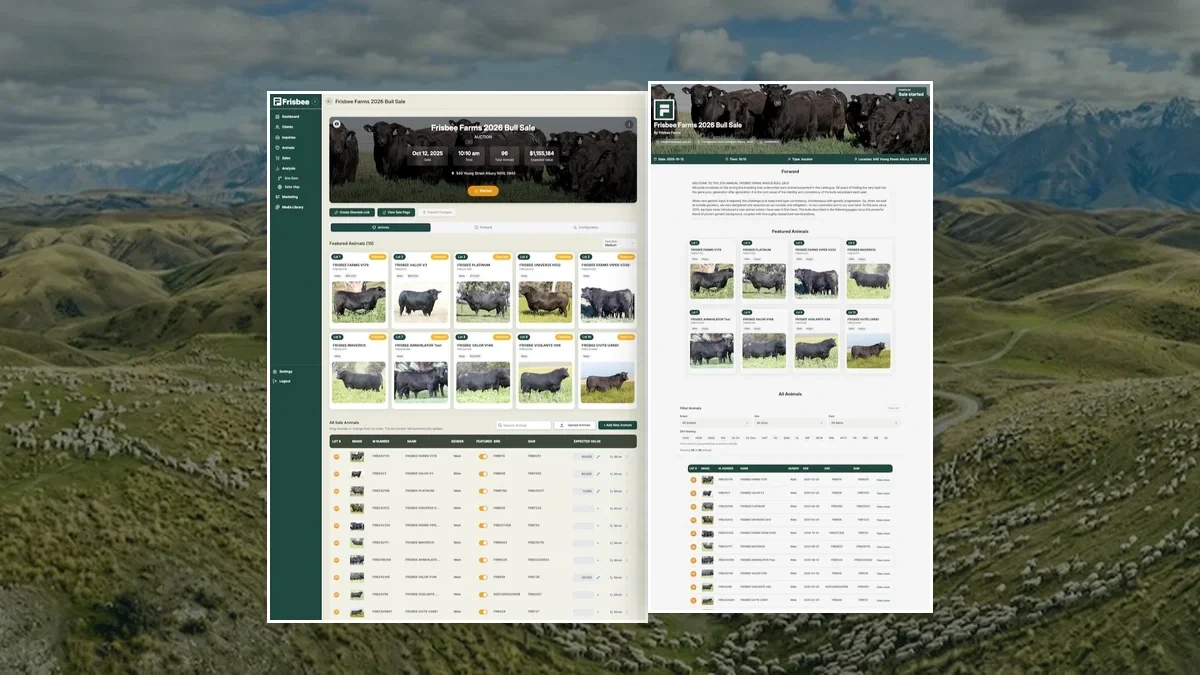
Sale season 2026 is coming. Bull sales kick off in June, ram sales follow through August to October, and right now is when serious preparation begins.
Your sale catalogue is the single most important marketing asset you produce all year. For interstate and international buyers who can’t inspect in person, the catalogue is your sale. Yet many studs are still copying EBVs into Word documents, dragging photos between folders, and exporting 15MB PDFs that bounce off email servers.
There’s a better way. For the complete sale workflow from planning through post-sale analysis, see our comprehensive bull sale guide. This post goes deep on the catalogue itself.
Why Your PDF Catalogue Is Holding You Back
PDF and print catalogues served the industry well, but buyer behaviour has changed.
Stale data. EBVs change, weights get updated, animals get withdrawn. With a PDF, every change means a new version and another email. By sale day, most PDF catalogues are out of date.
Poor distribution. Large files bounce off email servers, trigger spam filters, or won’t download on rural mobile data. You have zero visibility into who opened it or which lots attracted attention. And you can’t share a single lot on social media.
Bad buyer experience. A commercial producer looking for calving ease bulls by a specific sire has to scroll through every page. No filtering, no video, and on mobile it’s constant pinching and zooming.
Wasted effort. Manual assembly takes days — pulling data from breed society portals, matching photos, formatting in Word or InDesign. Every sale starts from scratch.
The Real Cost of Print vs Digital
| Cost Item | Professional Print | Digital Catalogue |
|---|---|---|
| Design and layout (graphic designer) | $1,500 – $3,000 | $0 (auto-generated) |
| Printing (200-300 copies) | $2,000 – $4,000 | $0 |
| Postage and distribution | $500 – $1,000 | $0 |
| Reprints for corrections/updates | $500+ | $0 (update instantly) |
| Total per sale | $4,500 – $8,500+ | Included in platform |
That’s before accounting for your time assembling the catalogue, delayed distribution costing you buyer attention, and the 70 unused copies sitting in a box in the shed.
Going digital doesn’t mean abandoning print. Many studs use a hybrid approach: digital as the primary channel with a small print run (30-50 copies) for VIP buyers and the sale day table. This cuts catalogue costs by 60-80%.
What a Modern Digital Catalogue Looks Like
We don’t mean a PDF flipbook. We mean an interactive, live, mobile-friendly sale page.
| Feature | PDF/Print Catalogue | Digital Catalogue |
|---|---|---|
| Updating data | Re-export, re-email, reprint | Automatic |
| Sharing individual lots | Not possible | Direct link per lot |
| Video content | Not supported | Embedded per lot |
| Buyer filtering | Manual page-turning | Filter by sire, trait, category |
| Mobile experience | Pinch and zoom | Responsive design |
| Analytics | None | Track views and engagement |
| Time to produce | Days to weeks | Hours |
| Cost per update | Reprint cost | Free |
One URL works everywhere — email, social media, WhatsApp, QR codes. Each lot has its own page with pedigree, EBVs/ASBVs, photos, video, and description. Custom stud branding applied consistently without needing a graphic designer.
What Makes a Digital Catalogue Convert
Lead with data. EBVs, ASBVs, and selection indexes should be prominent. Include percentile rankings — “Top 5% for 600-Day Weight” communicates more than the raw figure. A digital catalogue linked to your records updates automatically when breed societies publish new figures.
Write descriptions that add context. Don’t repeat what the data already shows. Cover what photos and numbers can’t: structural observations, breeding context, and use recommendations like “Suited to maiden heifers” or “Heavy muscling suits terminal crossing programs.”
Invest in photography and video. Professional side-profile photos are the minimum. Video is the single biggest differentiator for remote buyers — if you’re adding one new element this season, make it video. See our livestock photography guide for practical techniques.
Make it easy to act. Viewing dates, enquiry links, contact details, and share buttons should be visible on every lot page. Every barrier between “I’m interested” and “I’ve made contact” costs you bidders.
Building Your 2026 Catalogue: A Practical Timeline
Now (April – May): Finalise your sale draft, update animal records (weights, scans, EBVs, pedigrees), book photography and video, and upload media to your central system.
8–10 weeks out: Select sale lots, set lot order, write descriptions, apply branding, and generate your catalogue. Have your agent review it.
6–8 weeks out: Share with your agent for feedback. Send a VIP preview to your top 10-20 buyers. Test on mobile.
4–6 weeks out: Full distribution — email your buyer database, share on social media with direct lot links, post on your website, and follow up personally with key prospects. See our sale announcement email guide for crafting that email.
2–4 weeks out: Share individual lot spotlights. Monitor which lots are generating the most views — this intelligence helps your agent gauge demand.
Final week: Send a reminder email, confirm all data is current, share a “one week to go” post linking back to the full catalogue.
How Frisbee’s Catalogue Tools Work
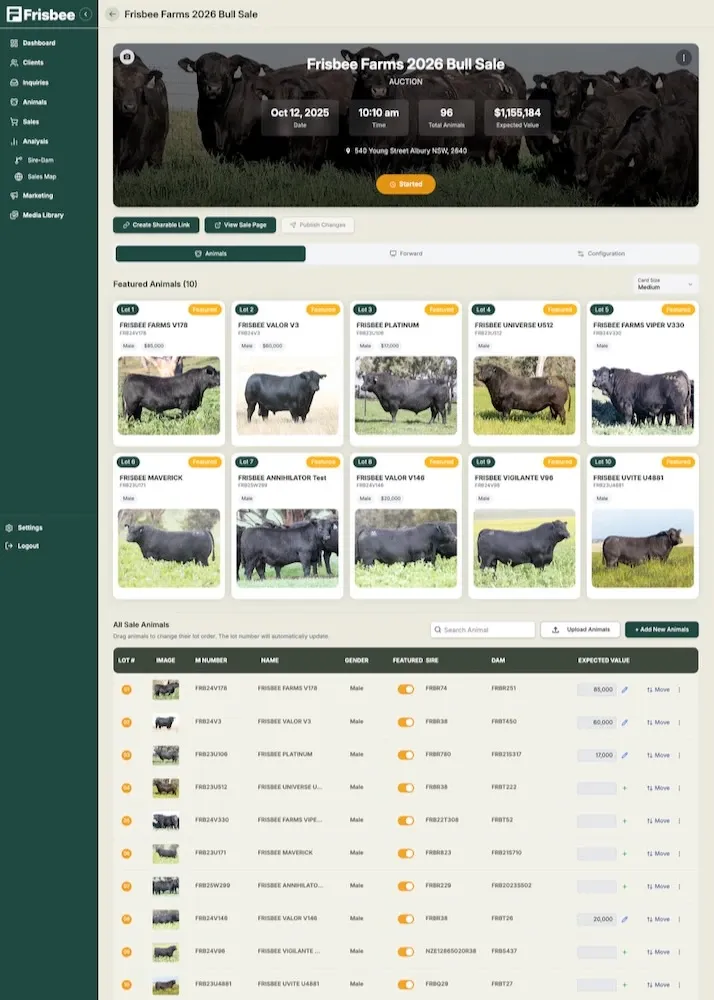
Select animals from your Frisbee database and the catalogue builds itself. Photos, pedigrees, EBVs, ASBVs, weights, and measurements populate automatically. When you update an animal record, the catalogue reflects the change immediately.
What you see — the management dashboard
What buyers see — the public catalogue
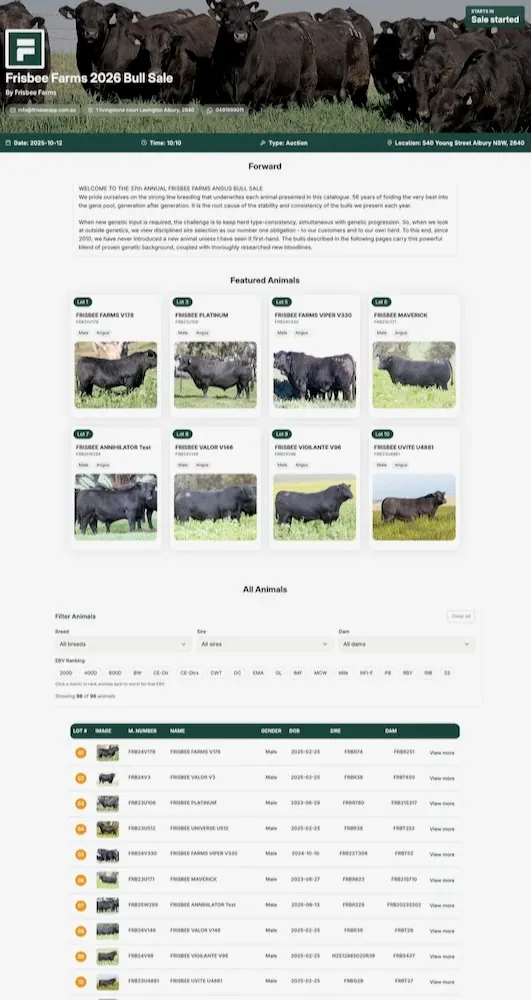
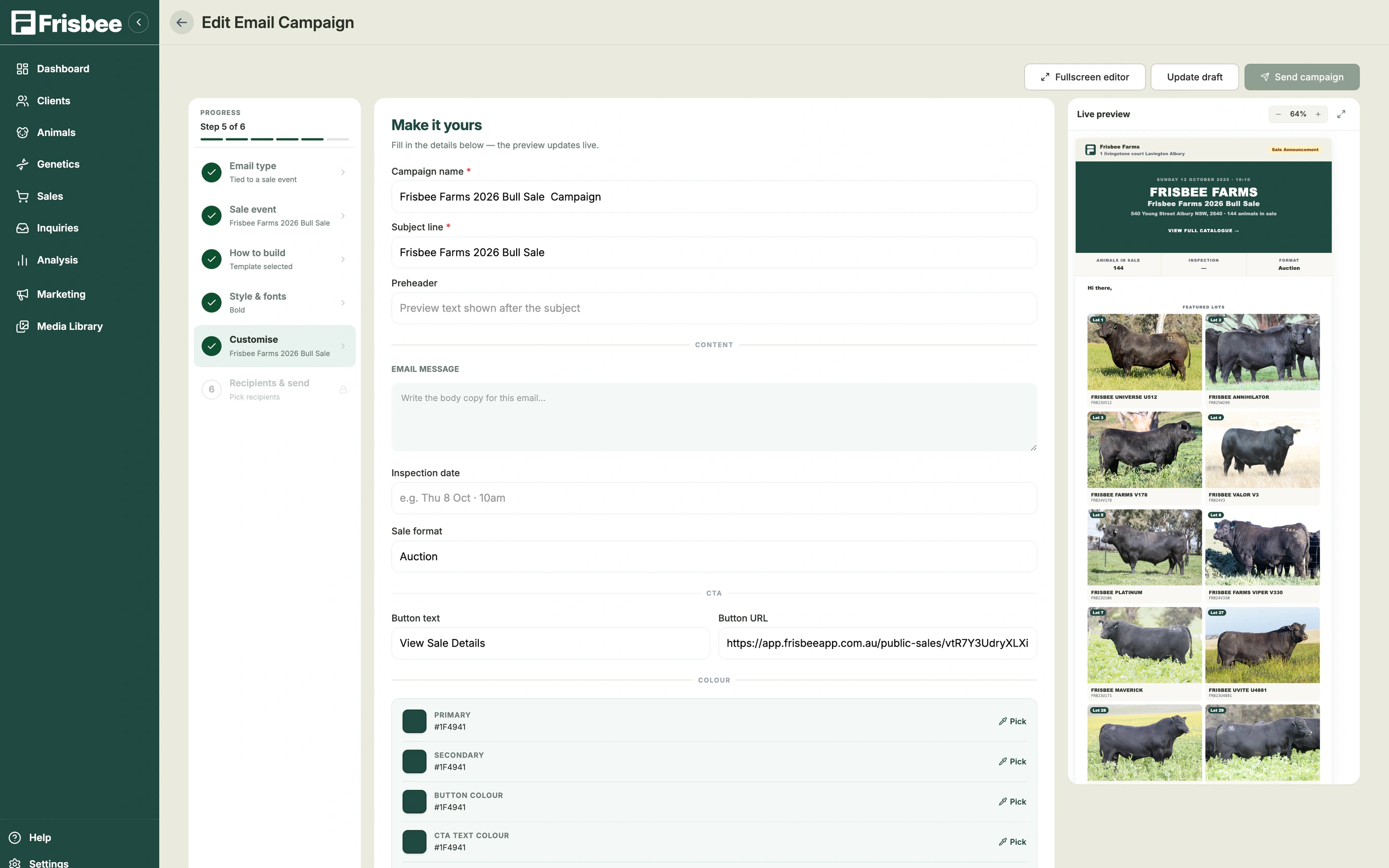
Add your stud logo and colours, set lot order, and write descriptions — all in one interface. Generate a single shareable URL and distribute it through email, social media, or your website. Attach video to individual lots for remote buyers.
Your catalogue integrates with Frisbee’s marketing and CRM tools: segmented distribution to targeted buyer lists, engagement tracking to see which lots generate interest, AI-assisted email generation for catalogue announcements and lot spotlights, and post-sale continuity that feeds buyer interactions back into your CRM.
Everything in this guide applies equally to ram sales. Frisbee supports both cattle and sheep breeds with the same catalogue, marketing, and CRM tools. For sheep-specific strategies, see our guide to marketing your sheep stud in 2026.
The Bottom Line
Your sale catalogue is the first impression most buyers have of your offering. A digital catalogue that’s live, mobile-friendly, filterable, and backed by current data gives buyers confidence and extends your reach well beyond your local area.
Sale season 2026 is weeks away. The technology exists to do this efficiently and affordably. The question is whether you’ll use it — or keep emailing PDFs and hoping for the best.
Ready to build your 2026 sale catalogue?
Frisbee’s catalogue tools pull directly from your animal records — photos, pedigrees, EBVs, and performance data populate automatically. Share one link and let buyers browse, filter, and shortlist lots on any device.
Book a Free Demo and we’ll build a sample catalogue from your stock in 10 minutes. Or explore the sale management features on your own.
Related reading:
- From Catalogue to Gavel: Streamlining Your Next Bull Sale
- The Anatomy of a High-Converting Sale Announcement Email
- AI Email Generation Is Here: Write Better Sale Emails in Minutes
- Livestock Photography 101: Capturing Genetics for Maximum Impact
Tagged
Run a sharper stud, on one platform.
Genetics, sales, clients and marketing — without the spreadsheet sprawl. Built for Australian cattle and sheep producers.
Get started with FrisbeeKeep reading
View all →
The Anatomy of a High-Converting Sale Announcement Email
How to craft sale announcement emails that livestock buyers open and act on, from subject line formulas to a ready-to-use template.
Livestock Photography 101: Capturing Your Genetics for Maximum Impact
How to photograph and film your livestock for maximum buyer impact, with practical tips on lighting, angles, and smartphone techniques.
Your Cattle Are World-Class. Your Marketing Should Be Too.
You have bred superior livestock, so make sure the right buyers see it. Frisbee brings professional email marketing into your livestock software.
Run your stud on Frisbee
CRM, sale catalogues, and marketing campaigns in one place, purpose-built for Australian cattle and sheep studs.
14-day free trial · No credit card required