
From Catalogue to Gavel: Streamlining Your Next Bull Sale
Preparation is the difference between an average and an exceptional bull sale. A complete guide to the workflow from planning to post-sale analysis.
Sale day is the most important day of the year for a stud producer. It’s where months of breeding decisions, years of genetic investment, and countless hours of animal preparation come together. It’s also, for many studs, the most stressful day of the year.
The logistics of organising lots, managing buyer communication, preparing catalogues, and tracking results can be overwhelming. Yet the studs achieving premium results consistently aren’t necessarily those with the best genetics - they’re the ones executing the sale process professionally at every stage.
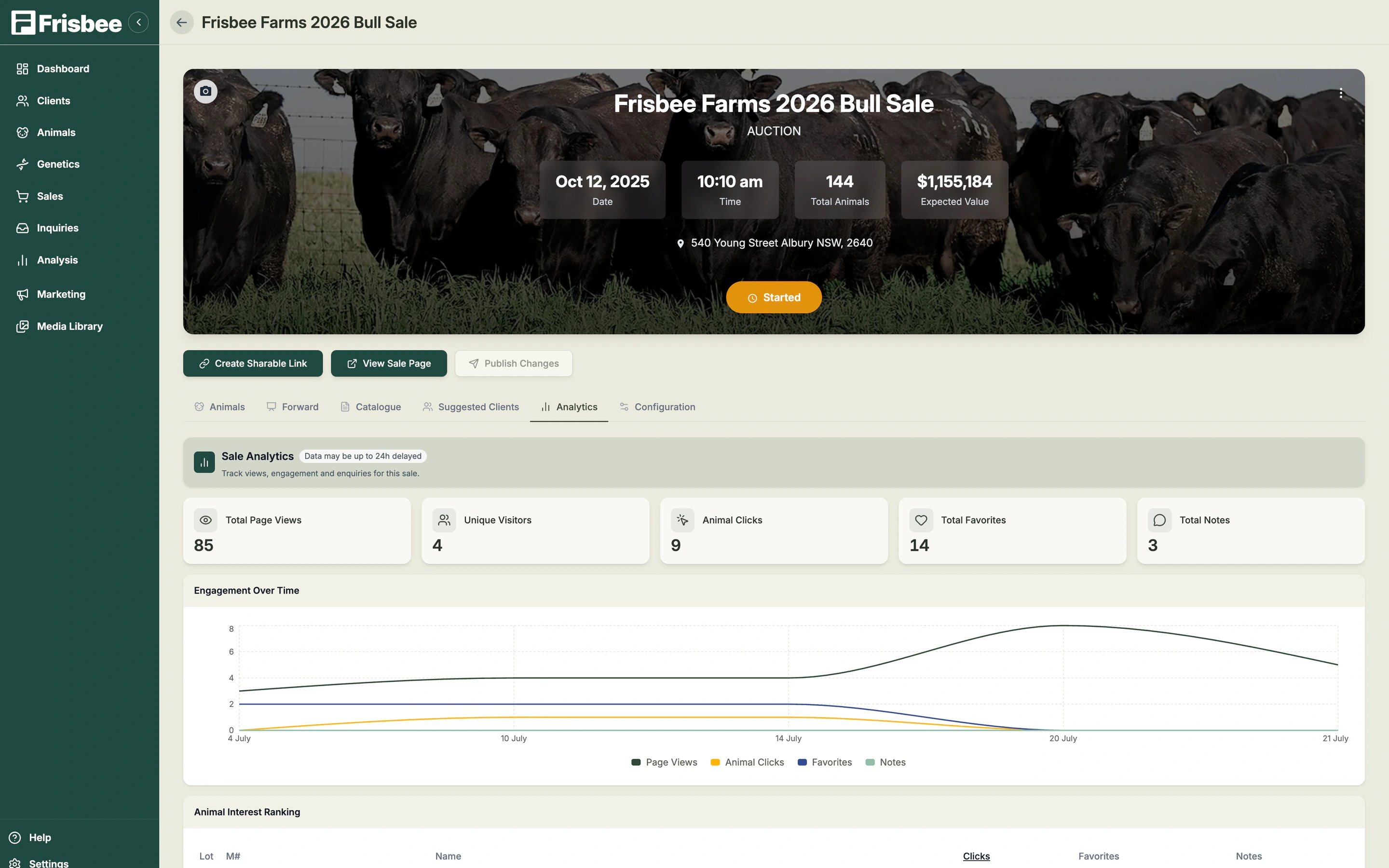
Frisbee’s Sales Event Management was designed to turn sale day chaos into a streamlined, professional operation. Here’s a comprehensive guide to the entire bull sale workflow - from early planning through post-sale analysis.
The Sale Success Formula
Successful bull sales share common elements:
- Early, thorough preparation: Not scrambling in the final weeks
- Professional presentation: Catalogue, animals, and property all reflecting quality
- Effective marketing: The right buyers knowing about the right animals
- Smooth execution: Sale day running without hitches
- Systematic follow-up: Relationships built that last beyond the sale
Let’s break down each phase.
Phase 1: Planning (6-12 Months Before)
Great sales start with early planning, not last-minute scrambling.
Setting Your Sale Date
Consider industry timing: Traditional sale seasons exist for reasons. Buyers budget and plan around expected timing. Going too early or late risks missing peak buyer attention.
Avoid major clashes: Check major competing sales in your breed and region. You don’t want to split your buyer pool with a neighbour’s sale.
Book services early: Auctioneers, professional photographers, and quality videographers are booked well in advance. Confirm early or miss out on your preferred providers.
Allow adequate preparation time: Work backward from sale day. How long does catalogue printing take? Photography scheduling? Marketing campaigns? Set your timeline accordingly.
Defining Your Offering
How many lots?: Quality over quantity. A sale with 30 excellent bulls builds stronger reputation than 60 mixed lots. Buyers remember your worst animals, not just your best.
What categories?: Age groups (yearlings, two-year-olds), quality tiers (elite, commercial), and any special offerings (AI sires, genetics from particular bloodlines).
Reserve pricing philosophy: Will you set reserves conservatively to maximise clearance, or aggressively to protect value? Different approaches suit different market conditions.
Early Marketing Planning
Identify key buyers: Who are your target purchasers? Volume commercial buyers? Stud breeders seeking genetics? First-time attendees you want to attract?
Plan communication timeline: When will you announce the sale? Release the catalogue? Send reminders? Map the buyer journey.
Content preparation: What photos, videos, and stories will support your marketing? Plan capture now, not weeks before the catalogue deadline.
Phase 2: Animal Preparation (3-6 Months Before)
Bulls don’t prepare themselves for sale in a week.
Physical Preparation
Condition targets: Bulls should be sale-ready - not fat, not thin. This takes months of nutrition management, not weeks.
Health protocols: Complete all vaccinations, testing, and treatments with appropriate time before sale. Withholding periods must be cleared.
Handling and training: Bulls that lead well and behave in the ring make better impressions. This takes regular handling over months.
Documentation Preparation
EBV verification: Check current breed society figures against your records. Ensure data is current and accurate.
Pedigree confirmation: Verify parentage, registration numbers, and any corrections needed well before catalogue deadlines.
Measurement completion: Any outstanding scans, weights, or other measurements should be completed with time for processing.
Photography and Video
Schedule professional photography: Book your livestock photographer with adequate time for:
- Weather contingencies
- Animal preparation
- Processing and delivery before catalogue deadlines
Video capture: If offering video, plan this alongside photography. Movement footage, temperament demonstration, and walk-throughs increasingly influence remote buyers.
Photo standards: Consistent backgrounds, lighting, and positioning across all lots allows fair comparison and professional presentation.
Phase 3: Catalogue Creation (4-8 Weeks Before)
Your catalogue is your primary marketing tool. It must be professional, accurate, and compelling.
Lot Organisation
Lot ordering strategy: Consider:
- Premium lots for peak attention times (often mid-sale)
- Related animals grouped (full brothers, dam families)
- Variety to maintain buyer interest through the sale
- Commercial-tier lots to provide entry points
Allow for changes: Animals may be withdrawn for health, sales, or condition issues. Build flexibility into your system.
Essential Lot Information
Every lot entry needs:
| Element | What to Include |
|---|---|
| Identification | Name, tattoo, birthdate, registration number |
| Pedigree | Three-generation minimum, formatted clearly |
| EBVs | Current figures with percentile rankings where helpful |
| Measurements | Scrotal, weight, frame score, any carcase scanning |
| Photos | Professional side profile minimum; front and additional angles for premium lots |
| Description | Written content adding what data alone doesn’t convey |
Writing Descriptions That Work
Good descriptions complement data rather than repeat it:
Structural observations: Comment on attributes photos and data can’t convey - movement quality, structural correctness, muscle pattern, masculinity.
Breeding context: What does this bull represent in your program? Is he from a proven dam family? A new genetic direction you’re excited about?
Use recommendations: Help buyers match animals to appropriate situations. “Suited to maiden heifers due to moderate birth weight and calving ease.” “Heavy muscling suits terminal crossing.” “Exceptional capacity for harder country.”
Honest assessment: Credibility comes from balanced descriptions. If every bull is “exceptional” and “outstanding,” the words lose meaning.
Catalogue Distribution
Digital first: Email to your buyer database with easy online viewing. Most buyers will review digitally before deciding whether to attend.
Print for key buyers: Physical catalogues for top clients, interstate prospects, and industry partners. Mailed with adequate time to arrive and be reviewed.
Website hosting: Catalogue accessible on your website with individual lot pages buyers can bookmark and share.
Social media sharing: Enable easy sharing of individual lots with direct links and formatted images.
Timing: Allow 3-4 weeks for buyers to review before sale day. Rushed distribution means rushed buyer evaluation.
Phase 4: Pre-Sale Marketing (2-6 Weeks Before)
Your catalogue is ready. Now get it in front of buyers.
Email Campaign Sequence
Announcement (6-8 weeks out): Sale date confirmation, offering highlights, save-the-date call to action.
Catalogue release (3-4 weeks out): Full catalogue access, feature lots highlighted, viewing opportunity details.
Feature spotlights (2-3 weeks out): Individual animal or sire group features with deeper content than catalogue entries allow.
Final reminder (1 week out): Logistics details, registration closing, urgency messaging.
Direct Outreach
Not all communication should be mass marketing:
Phone key prospects: Personal calls to your best buyers. What are they looking for this year? Which lots suit their needs?
Agent briefings: Keep stock agents informed about your offering. They influence purchasing decisions.
Industry relationships: Brief breed society contacts, industry writers, and other influencers who might mention your sale.
Pre-Sale Enquiry Management
Track all pre-sale contact:
- Record which lots generate enquiries
- Note specific interests and questions asked
- Log follow-up commitments
- Track which buyers are registering
This intelligence helps you gauge likely demand before sale day.
Phase 5: Sale Day Execution
The big day arrives. Preparation pays off.
Before the Gavel Falls
Final lot verification: Confirm all lots are present, correctly identified, and sale-ready.
Information access: Have complete lot details accessible for any questions. Complete data on phone or tablet, not locked on an office computer.
Buyer registration: Smooth registration process capturing buyer details for your database.
Venue presentation: Property tidy, animals well-presented, hospitality welcoming. First impressions matter.
During the Sale
Real-time recording: As lots sell:
- Record price immediately
- Capture buyer details
- Note any relevant observations
Handle changes: Sales rarely run perfectly:
- Lots withdrawn? Update your system
- Order changes? Communicate clearly
- Questions arise? Access information fast
Stay accessible: Be available to answer buyer questions, provide additional information, and facilitate decisions.
Technology on Sale Day
Reliable connectivity: If your property has patchy coverage, consider temporary connectivity solutions. Online bidding integration fails without reliable internet.
Charged devices: Phones and tablets charged, apps updated, passwords confirmed.
Backup plans: What happens if technology fails? Have manual processes ready.
Phase 6: Post-Sale (Immediately After)
The gavel falls on the last lot. Your work isn’t quite done.
Immediate Follow-Up
Buyer confirmation: Within hours, send purchase confirmations with payment and collection details. Professional studs confirm promptly.
Thank you messages: Personal thanks to all buyers, especially first-time purchasers. This moment shapes long-term relationships.
Unsuccessful bidder follow-up: Contact serious underbidders about passed-in lots or next sale opportunities.
Attendee acknowledgment: Thank everyone who attended, even those who didn’t purchase.
Delivery and Settlement
Clear logistics: Provide detailed pickup or delivery instructions promptly.
Flexible arrangements: Accommodate reasonable buyer needs for timing and transport within your operational constraints.
Settlement efficiency: Make payment easy with clear instructions and multiple options.
Documentation: Provide all transfer paperwork promptly and accurately.
Post-Sale Analysis
Every sale generates insights for improvement:
Performance metrics:
- Clearance rate (lots sold vs offered)
- Average price (overall and by category)
- Top and bottom prices achieved
- Comparison to previous sales
Buyer analysis:
- New versus repeat buyer ratio
- Geographic distribution
- Which marketing drove which buyers
What worked, what didn’t:
- Which lots exceeded expectations? Why?
- Which underperformed? Why?
- What would you do differently?
Common Sale Mistakes to Avoid
Preparation Phase
- Leaving photography until the last week
- Not updating EBVs before catalogue printing
- Incomplete pedigree verification
- Bulls in wrong condition (too fat or too thin)
Marketing Phase
- Generic emails to entire database without segmentation
- Releasing catalogue too close to sale day
- No follow-up to catalogue distribution
- Ignoring pre-sale enquiries
Sale Day
- No technology backup plans
- Key information inaccessible when needed
- Poor lot presentation or handling
- Venue looking unprofessional
Post-Sale
- Delayed buyer communication
- No follow-up with unsuccessful bidders
- Not capturing lessons for improvement
- Forgetting to update buyer database
Sale Day Checklist
One Week Before
- All lots confirmed and sale-ready
- Catalogue distributed to all targets
- Registration system tested
- Venue and hospitality confirmed
- Technology checked and charged
Day Before
- Animals positioned and settled
- Venue final preparation
- Registration materials ready
- All team briefed on responsibilities
- Weather contingencies confirmed
Sale Morning
- Animals fed and settled
- Team in position
- Registration open and flowing
- Technology operational
- Buyer welcome underway
During Sale
- Results recording current
- Buyer questions answered
- Any issues addressed promptly
- Sale progress communicated
After Sale
- Results confirmed with auctioneer
- Buyer confirmations sent
- Thank you messages dispatched
- Analysis commenced
The Bottom Line
A professional bull sale maximises the return on years of breeding work. The difference between well-prepared and chaotic sales can be substantial - in prices achieved, buyer relationships built, and stress experienced.
Technology doesn’t replace good stock or good stockmanship. But it handles the complexity so you can focus on what matters: presenting your best animals to the right buyers.
Take the stress out of sale day.
Ready to streamline your next sale?
Frisbee powers livestock auctions from catalogue creation to final gavel - giving you more time to focus on your cattle and your clients.
See How Frisbee Powers Livestock Auctions
Related reading:
- Running a Successful Bull Sale: From Catalogue to Gavel
- Sale Day Success: Preparing Your Bull Sale with Software
Tagged
Run a sharper stud, on one platform.
Genetics, sales, clients and marketing — without the spreadsheet sprawl. Built for Australian cattle and sheep producers.
Get started with FrisbeeKeep reading
View all →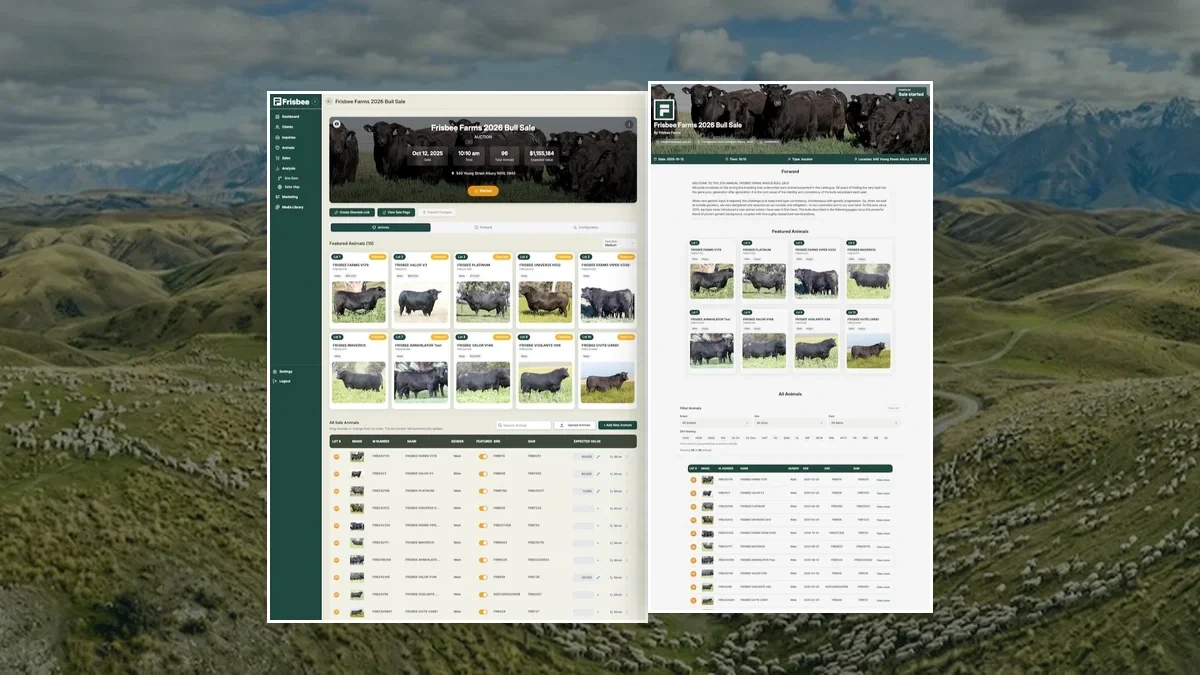
Build a Digital Sale Catalogue That Sells: A 2026 Guide
Why digital sale catalogues outperform PDFs and print, what makes them convert browsers into bidders, and how to build one that sells your genetics.
The Anatomy of a High-Converting Sale Announcement Email
How to craft sale announcement emails that livestock buyers open and act on, from subject line formulas to a ready-to-use template.
Livestock Photography 101: Capturing Your Genetics for Maximum Impact
How to photograph and film your livestock for maximum buyer impact, with practical tips on lighting, angles, and smartphone techniques.
Run your stud on Frisbee
CRM, sale catalogues, and marketing campaigns in one place, purpose-built for Australian cattle and sheep studs.
14-day free trial · No credit card required