
The Anatomy of a High-Converting Sale Announcement Email
How to craft sale announcement emails that livestock buyers open and act on, from subject line formulas to a ready-to-use template.
You’ve spent months - years, really - selecting genetics, managing your herd, and preparing your sale offering. Now you need buyers in seats on sale day. And despite what social media might suggest, email remains the single most effective channel for driving sale attendance.
But there’s a canyon between “sending an email” and sending one that actually gets opened, read, and acted upon. Most sale announcement emails get buried in cluttered inboxes because they look and feel like every other message competing for attention.
This guide breaks down the anatomy of a sale announcement email that converts - from the subject line to the final call-to-action - so you can build one that does your genetics justice.
Subject Lines That Actually Get Opened
Your subject line is the gatekeeper. If it doesn’t earn the open, nothing else matters.
What Doesn’t Work
Generic subject lines are invisible. They blend into the inbox and get scrolled past:
- “Spring Newsletter”
- “Stud Update - March”
- “News from [Stud Name]”
- “Important Update”
These tell the buyer nothing specific and give them no reason to open now rather than later (which means never).
What Does Work
Effective subject lines are specific, timely, and benefit-driven. They tell the reader exactly what’s inside and why they should care right now.
Formula 1: Action + Offering + Timeframe
- “Catalogue Live: 2026 Spring Bull Sale - 45 Angus Bulls”
- “Now Open: Ram Sale Registration - 12 September”
- “Bidder Registration Closing: Autumn Bull Sale - Friday”
Formula 2: Highlight + Specificity
- “Meet Our Top-Indexed Sire Son - Lot 1 Preview”
- “3 Sons of [Sire Name] in This Year’s Offering”
- “First Look: 60 Bulls Catalogued for October”
Formula 3: Urgency + Clear Value
- “Sale This Saturday: Final Viewing Tomorrow”
- “Catalogue Closes Friday - 38 Lots Still Available”
- “Last Chance to Register: On-Property Sale 15 March”
Subject Line Tips
- Keep it under 50 characters where possible. Most mobile email clients truncate beyond this.
- Put the key information first. If it gets cut off, the important part still shows.
- Use numbers. “45 Bulls” is more concrete than “our offering.”
- Avoid spam triggers. All caps, excessive exclamation marks, and words like “FREE” or “ACT NOW” hurt deliverability.
- Test variations. If your email platform supports A/B testing, try two subject lines and let data decide.
The Ideal Email Structure
A high-converting sale email balances information, visually, and clarity. It’s not a catalogue - it’s an invitation to engage with the catalogue.
1. Header: Brand and Context
Start with your stud logo and sale branding. This immediately tells the reader who it’s from and establishes professionalism. Keep it clean - a logo, sale name, and date is plenty.
2. Opening: The Hook (2-3 Sentences)
Get to the point. Why are you emailing? What should the reader care about?
Strong opening example:
“Our 2026 Spring Bull Sale catalogue is now live. Forty-five Angus bulls, including seven sons of [Sire Name] and our strongest set of growth EBVs to date. Here’s what’s on offer.”
Weak opening example:
“We hope this email finds you well. As the spring season approaches, we wanted to take this opportunity to share some exciting news about our upcoming sale event…”
Nobody has time for preamble. Lead with the substance.
3. Visual Hero: One Strong Image
Include one high-quality image - your standout lot, a group shot of the offering, or your sale header image. One powerful image beats five mediocre ones. This isn’t the place for a photo gallery; it’s the hook that makes buyers want to see more.
4. Key Details: The Essentials
Present the critical information buyers need, clearly formatted:
- Sale date and time
- Location (with link to map or directions)
- Number of lots and breed
- Inspection and viewing dates
- Auctioneer and agents
Use bold text, bullet points, or a simple table. Don’t bury these details in prose.
5. Offering Highlights: EBVs and Standout Genetics
This is where you earn the click-through to your catalogue. Highlight 2-3 lots or themes:
- “Lot 1: Top 1% Growth, son of [Sire Name] - EBVs: 600DW +120, EMA +8.2”
- “Seven maternal sires with Calving Ease Direct in the top 10%”
- “Average index of the offering sits 15 points above breed average”
Keep EBV references focused. Pick the traits most relevant to your buyers. A commercial cattleman cares about growth and carcase traits. A stud breeder might focus on indexes and pedigree depth. Know your audience.
6. Primary Call-to-Action
One clear, prominent button or link. Not three. Not five. One.
- “View the Full Catalogue”
- “Register to Bid”
- “Download the Catalogue PDF”
Make it visually obvious - a coloured button, larger text, or clearly formatted link. The entire email builds toward this action.
7. Secondary Information (Below the Fold)
After the primary CTA, you can include supporting details for buyers who want more:
- Accommodation options for interstate buyers
- Online bidding details and platform links
- Contact information for enquiries
- Links to video content or individual lot pages
8. Footer: Contact and Legal
Your contact details, social media links, unsubscribe option, and any legal requirements. Standard, but essential.
Designing CTAs That Drive Action
Your call-to-action determines whether the email achieves its purpose or just gets appreciated and forgotten.
Make It Specific
Weak: “Click Here” or “Learn More” Strong: “View the Full Catalogue” or “Register to Bid Now”
Specific CTAs set clear expectations. The buyer knows exactly what happens when they click.
Make It Visible
Your primary CTA should be impossible to miss:
- Use a button format rather than a text link
- Choose a contrasting colour that stands out from the email body
- Place it after your offering highlights but before secondary information
- Consider repeating it at the bottom for long emails
Make It Urgent (When Appropriate)
Adding a deadline creates momentum:
- “Register Before Friday 8 March”
- “Catalogue Available Until Sale Day”
- “Early Bird Inspection: Book Your Slot”
Don’t fabricate urgency. But if genuine deadlines exist - registration closing dates, viewing windows, early access periods - use them.
One Primary, One Secondary
If you must include two actions, make the hierarchy clear:
- Primary (button): “View the Catalogue”
- Secondary (text link): “Register to Bid”
Never give equal visual weight to competing actions. The buyer shouldn’t have to choose.
A Mini-Template You Can Use
Here’s a skeleton structure you can adapt for your next sale announcement. Replace the bracketed sections with your details.
Subject: Catalogue Live: [Year] [Sale Name] - [Number] [Breed] [Bulls/Rams]
[Stud Logo]
[Year] [Sale Name]
[One strong hero image of top lot or offering group]
[2-3 sentence opening. State what’s on offer and why it matters. Be specific - number of lots, standout genetics, notable EBV highlights.]
Sale Details
- Date: [Day, Date, Time]
- Location: [Venue] - [Link to directions]
- Offering: [Number] [Breed] [Bulls/Rams]
- Auctioneer: [Name, Agency]
- Inspections: [Date and time for pre-sale viewing]
Offering Highlights
[Highlight 2-3 lots or themes with brief EBV/index references]
- Lot [X]: [Animal Name] - [Key trait], [Key EBV]. [One sentence description.]
- Lot [X]: [Animal Name] - [Key trait], [Key EBV]. [One sentence description.]
- [Broader theme]: [e.g., “Average 200DW EBV of the offering sits in the top 15% of the breed.”]
[View the Full Catalogue →] (Primary CTA button)
Viewing & Logistics
- Pre-sale inspections: [Details]
- Accommodation: [Suggestions or link]
- Online bidding: [Platform and registration link]
Questions? Contact [Name] on [Phone] or [Email].
[Social media links] | [Unsubscribe]
Using the Template
- Adapt the tone to your stud’s voice. If you’re naturally casual, write casually. If you’re formal, stay formal. Consistency matters more than style.
- Don’t overfill it. The template works because it’s focused. Resist the urge to add “just one more section.”
- Test on mobile first. Send yourself a test email and read it on your phone. If anything looks awkward, fix it before sending to your list.
- Personalise where possible. If your email platform supports merge fields, use the buyer’s first name. “G’day [First Name]” outperforms “Dear Valued Client” every time.
Common Mistakes to Avoid
Sending too late. Catalogue emails should land 3-4 weeks before sale day, not the week of. Give buyers time to review.
Overloading with content. Your email isn’t the catalogue. It’s the invitation to view the catalogue. Keep it focused.
Forgetting mobile. Over 60% of emails are opened on smartphones. If your email doesn’t look right on a phone screen, most of your audience won’t see it properly.
No clear action. Every email needs a purpose. If you can’t articulate what you want the reader to do after reading, rewrite it.
Inconsistent branding. Your email should look like it came from the same operation as your catalogue, website, and sale signage. Consistent branding builds trust.
The Bottom Line
A sale announcement email isn’t a formality - it’s your most direct line to buyers. The difference between an email that gets opened and one that gets deleted often comes down to a specific subject line, a clean structure, and a clear call-to-action.
You don’t need a marketing degree to send effective sale emails. You need a clear offering, a focused message, and the discipline to keep it simple. Use the template above as your starting point, refine it with each sale, and pay attention to what your open rates and click-through rates tell you.
Your genetics deserve to be seen by the right buyers. Make sure your emails make that happen.
Ready to send sale emails that actually convert?
Frisbee’s integrated email marketing lets you build campaigns directly from your herd and client data - no exporting, no formatting headaches. Segment your buyer list, attach animal profiles, and track who’s engaging with your offering.
Book a Free Demo to see how Frisbee can transform your sale marketing.
Related reading:
Tagged
Run a sharper stud, on one platform.
Genetics, sales, clients and marketing — without the spreadsheet sprawl. Built for Australian cattle and sheep producers.
Get started with FrisbeeKeep reading
View all →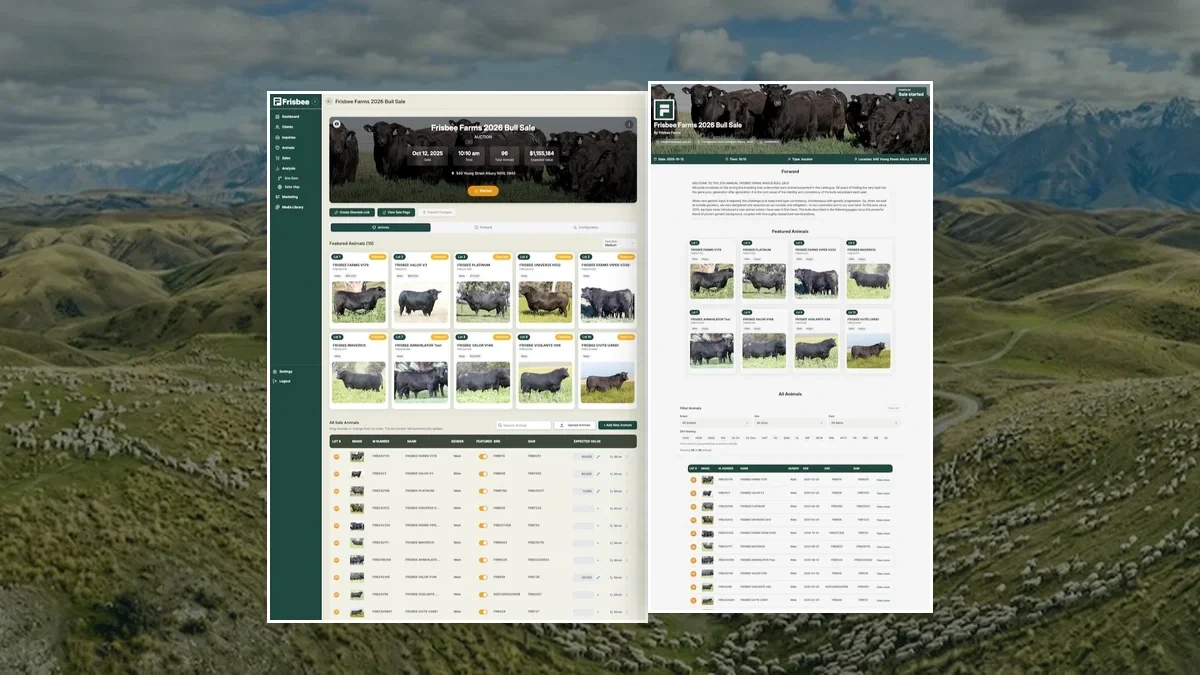
Build a Digital Sale Catalogue That Sells: A 2026 Guide
Why digital sale catalogues outperform PDFs and print, what makes them convert browsers into bidders, and how to build one that sells your genetics.
Livestock Photography 101: Capturing Your Genetics for Maximum Impact
How to photograph and film your livestock for maximum buyer impact, with practical tips on lighting, angles, and smartphone techniques.
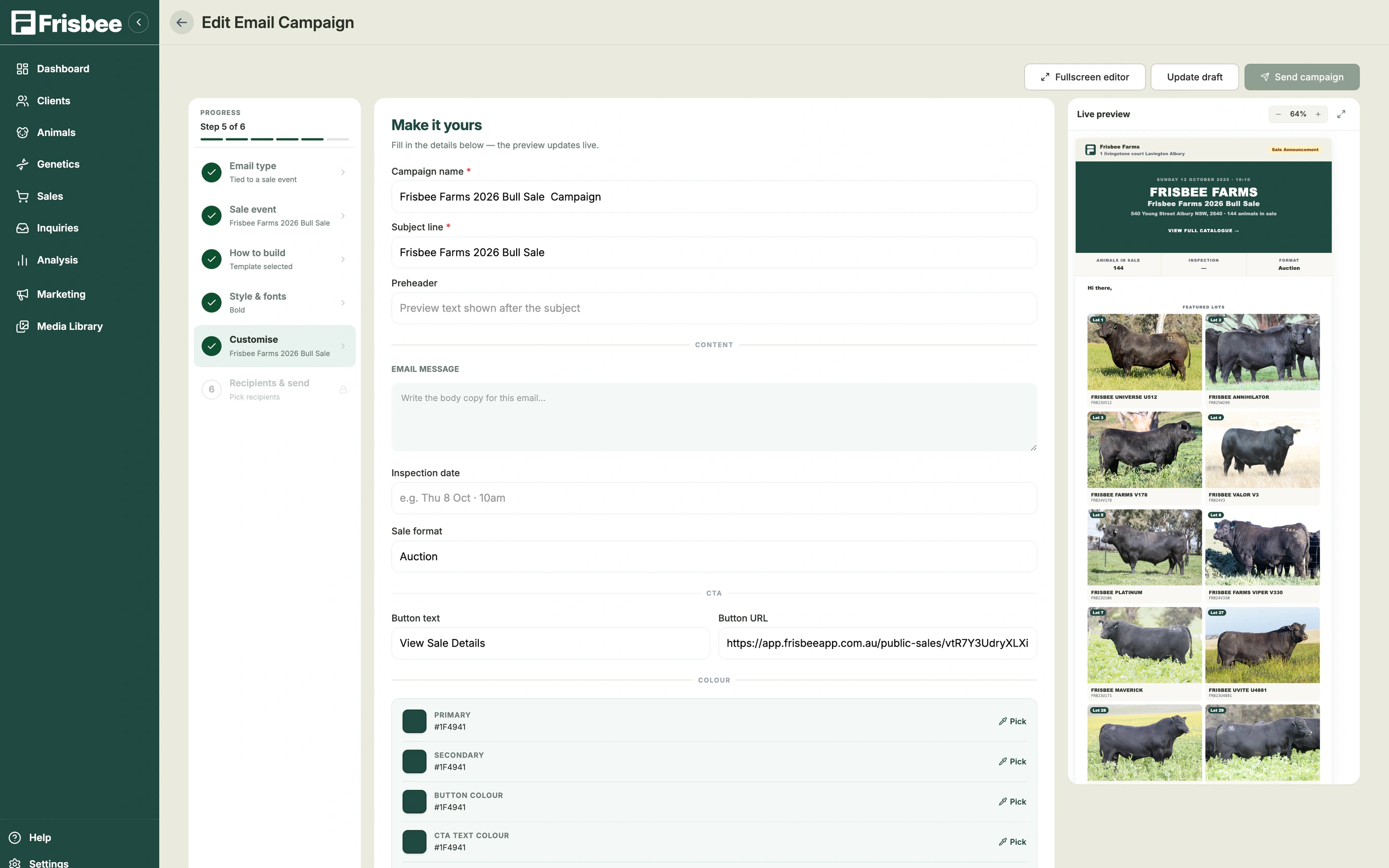
Your Cattle Are World-Class. Your Marketing Should Be Too.
You have bred superior livestock, so make sure the right buyers see it. Frisbee brings professional email marketing into your livestock software.
Run your stud on Frisbee
CRM, sale catalogues, and marketing campaigns in one place, purpose-built for Australian cattle and sheep studs.
14-day free trial · No credit card required